


Modelli finanziari
Quanto guadagna un barbiere?
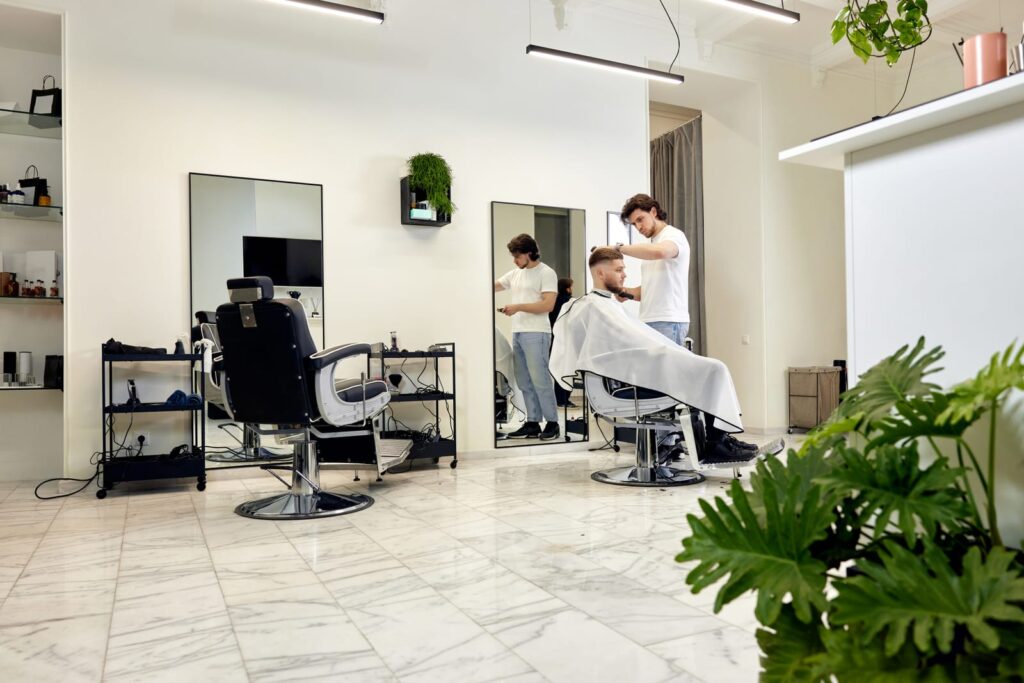
A barber shop is a chair-turning, retention-driven grooming business where profitability hinges on seat occupancy, average ticket size, and rebooking frequency.
The model works when three variables are controlled together: chairs multiplied by turns per day multiplied by average ticket, minus a labor cost structure that stays below 50% of revenue.
The spread between a poorly run shop ($50,000 in annual revenue) and a well-run operation ($300,000 or more) is enormous, driven almost entirely by operational discipline, not market size.
Configurazione delle risorse
The economic question is not “how nice is the shop” but “what annual build-out cost per chair can the revenue per chair sustain.”
A professional shop requires 800 to 2,000 square feet, 4 to 10 cutting stations, a reception area, and back-bar inventory. Booth rental models reduce upfront capital but limit brand control and revenue capture.
| Categoria di attività | Standard Build-Out (USD) | Premium/Luxury Format (USD) | What Drives the Number |
| Leasehold improvements (flooring, walls, plumbing, electrical) | 15,000 to 35,000 | 35,000 to 80,000 | Condition of raw space; finish level |
| Barber chairs (4 to 8 stations) | 4,000 to 12,000 | 12,000 to 40,000 | $500 to $1,500 per chair; brand and hydraulics |
| Mirrors, lighting, cabinetry | 3,000 to 8,000 | 8,000 to 20,000 | Ambiance positioning |
| Waiting area and reception | Da 2.000 a 5.000 | 5,000 to 15,000 | Seating capacity and brand impression |
| POS, booking software, Wi-Fi | da 1.500 a 3.000 | Da 3.000 a 6.000 | Manual vs automated scheduling |
| Initial product inventory (back-bar and retail) | Da 2.000 a 5.000 | 5,000 to 12,000 | Retail ambition and brand partnerships |
| Signage, branding, launch marketing | Da 2.000 a 5.000 | 5,000 to 12,000 | Street visibility and digital presence |
| Licensing, permits, insurance | da 1.500 a 3.000 | da 3.000 a 7.000 | Jurisdiction and liability coverage |
| Working capital (first 60 days) | 8,000 to 20,000 | 15,000 to 35,000 | Payroll float and rent deposit |
| Total Estimated CapEx | 39,000 to 96,000 | 91,000 to 227,000 |
Build-out cost per chair is the key stress test.
Formula: CapEx per chair = Total build-out cost / Number of stations
Esempio: $72,000 / 6 chairs = $12,000 per chair
If each chair generates $50,000 in annual revenue, the build-out is recovered in under 3 months of operation per chair. A healthy CapEx-to-annual-revenue-per-chair ratio is below 0.30. Above 0.50 signals over-investment relative to earning power.
Modello di ricavi
Service revenue from haircuts and grooming is the engine, typically 80% to 90% of total revenue. Revenue is a direct function of chairs, daily turns per chair, average ticket, and operating days.
Core formulas:
- Ricavi da servizi = Chairs x Turns per chair per day x Average ticket x Operating days per year
- Total revenue = Service revenue + Retail sales + Membership fees
Worked example for a 6-chair shop:
Assume 6 chairs, 6 turns per chair per day (one client every 50 minutes), average ticket of $38 (haircut plus occasional add-ons), 305 operating days.
Ricavi da servizi = 6 x 6 x $38 x 305 = $418,104
| Flusso di entrate | Ricavi annuali (USD) | Assunzione |
| Haircuts and core grooming | 370,260 | 6 chairs x 5.4 avg turns x $35 base x 305 days |
| Premium add-ons (beard trim, hot towel, scalp massage) | 47,844 | 35% attach rate on core services at $12 avg add-on |
| Retail product sales (pomade, beard oil, shampoo) | 21,960 | 6 chairs x 305 days x $2.00 avg retail per client visit |
| Membership/subscription fees | 23,760 | 110 members x $18/month x 12 months |
| Totale | 463,824 |
The average male client visits approximately 12 times per year. A 6-chair shop serving 36 clients per day across 305 days processes 10,980 visits annually.
Revenue per chair = $463,824 / 6 = $77,304
Well-run barber shops generate $60,000 to $100,000 per chair annually. Below $50,000 per chair signals either underpricing, low occupancy, or insufficient operating hours.
Costi operativi
Barber shops are labor businesses. Compensation typically consumes 40% to 55% of revenue. Rent is the second-largest line at 10% to 18%. Everything else is relatively lean.
Start with labor math.
Most shops pay barbers via commission (40% to 50% of service revenue) or hourly wage plus tips. Commission models align cost with revenue and reduce fixed payroll risk.
Barber commission per barber: ($370,260 / 6) x 0.45 = $27,770. Total for 6 barbers: $166,617.
Add a shop manager at $40,000 and payroll taxes at 12%.
Total labor cost = ($166,617 + $40,000) x 1.12 = $231,411
| Categoria di costo | Costo annuale (USD) | Appunti |
| Barber commissions and wages | 166,617 | 45% commission on service revenue |
| Manager salary | 40,000 | Scheduling, inventory, front desk oversight |
| Payroll taxes and benefits | 24,794 | 12% burden on total compensation |
| Affitto | 42,000 | $3,500/month; 9% of revenue |
| Utilities (electric, water, internet) | 6,600 | $550/month |
| Supplies and back-bar products | 14,400 | $1,200/month; towels, blades, sanitizer, product |
| Retail COGS | 13,176 | 40% margin on $21,960 gross retail |
| Insurance (liability, property, WC) | 5,400 | Risk profile and employee count |
| Marketing and client acquisition | 9,600 | $800/month; social media, referrals, local ads |
| Booking software and POS | 3,600 | $300/month SaaS and processing fees |
| Equipment maintenance and replacement | 4,800 | Clippers, chairs, fixtures lifecycle |
| Accounting, legal, miscellaneous | 4,800 | Back-office and compliance |
| Costi operativi totali | 341,287 |
Profit math:
Operating profit = $463,824 – $341,287 = $122,537
Operating margin = $122,537 / $463,824 = 26.4%
| Metrico | Value |
| Ricavi totali | $463,824 |
| Costi operativi totali | $341,287 |
| Operating Profit (EBITDA proxy) | $122,537 |
| Margine operativo | 26.4% |
| Revenue per Chair | $77,304 |
| Profit per Chair | $20,423 |
Well-run barber shops target 20% to 30% EBITDA margins. Below 15% signals either overstaffing, underpricing, or rent burden.
Break-even daily clients:
Monthly fixed costs (rent, insurance, software, utilities, admin) = approximately $5,600. Daily fixed cost = $5,600 x 12 / 305 = $220.
Average ticket = $38. Variable cost per client (commission plus supplies) = $17.60. Contribution per client = $20.40.
Break-even = $220 / $20.40 = 10.8, so 11 clients per day
On a 6-chair shop capable of 36 clients per day, break-even occurs at just 30% seat occupancy. This low threshold is the structural advantage of the barbershop model.
Strategie di redditività
These strategies only matter once the base model is sound: labor below 50% of revenue, chairs running above 60% occupancy, and pricing that protects average ticket.
1. Turns per chair, not chairs
Adding a seventh chair does not help if chairs one through six are running at 60% occupancy. Maximize turns per station before expanding capacity. Target 6 to 8 turns per chair per day. Each additional turn per chair across 6 chairs at $38 ticket and 305 days adds $69,540 in annual revenue.
2. Average ticket engineering
A $35 haircut at 35% add-on attach rate with a $12 average add-on produces a $39.20 blended ticket, 12% above base. Introduce tiered add-ons: beard trim ($10), hot towel finish ($8), scalp treatment ($15). Moving attach rate from 20% to 40% on a 10,980-visit base adds $26,352 in annual revenue with near-zero incremental cost.
3. Membership as a cash flow anchor
Subscription models (“2 cuts per month for $55”) stabilize revenue and shorten rebooking cycles. A member visiting twice monthly generates $660 annually versus $420 for a walk-in visiting 12 times at $35. The 57% revenue lift per member comes with zero acquisition cost on repeat visits.
4. Retail as margin, not afterthought
Retail product sales carry 50% to 60% gross margins and require no incremental labor. Track retail revenue per client visit. A baseline target is $2.50 per visit. On 10,980 annual visits, moving from $1.50 to $3.00 per visit adds $16,470 in annual revenue at roughly $9,000 in incremental margin.
5. Standardize service duration
Revenue per hour is the hidden metric. A 30-minute haircut at $35 yields $70 per chair-hour. A 45-minute haircut at $40 yields $53 per chair-hour. Standardize core services at 30-minute slots, reserve 45- to 60-minute slots for premium services priced at $55 or more.
E allora?
A barber shop can generate $100,000 to $150,000 in annual operating profit on a 6-chair setup, but only when run as a throughput and retention business, not a walk-in trade.
Maximize turns per chair, engineer average ticket through add-ons and memberships, keep labor below 50% of revenue, and treat retail as a margin contributor.
Target 20% to 30% EBITDA margins with break-even at under 35% seat occupancy. The operators who win measure revenue per chair-hour, track rebooking rate, and treat every empty chair-slot as lost margin.

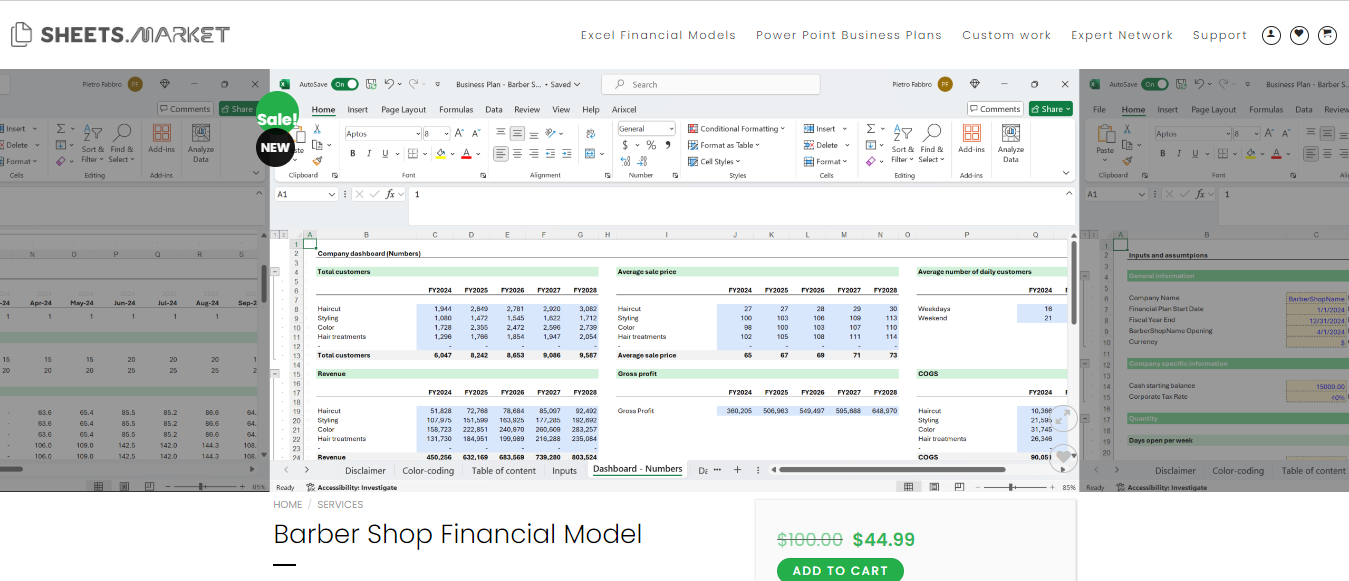
If you want to estimate revenue, costs, and profit using real inputs (chair count, pricing, turns per day, staffing, and expenses), use this template to run the numbers fast: Get the Barber Shop Financial Model.
