


Business Planning & Strategy
How Much Does a Hair Salon Make?
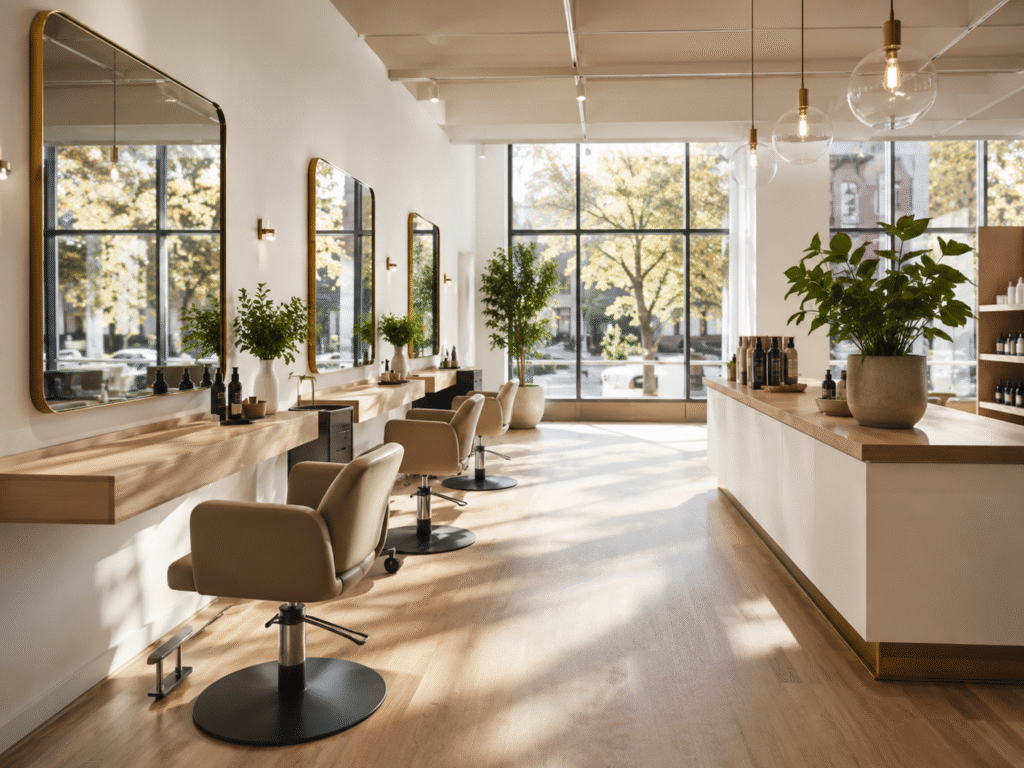
A hair salon is a payroll-driven business where profit is decided by average ticket, chair utilization, and commission structure, not by raw foot traffic.
The model works when pricing, service mix, and labor cost are engineered together, because stylist commission is structurally the dominant cost and service revenue is structurally the dominant revenue line.
The hard truth is a thin floor: industry net margins commonly sit near 8%, so a salon can be fully booked and still keep little after payroll, rent, and product.
The numbers below model an established six-chair commission salon in a mid-market urban or suburban setting, the format that most owners actually run and the one where the levers are sharpest.
Asset Configuration
The economic question is not “how stylish is the buildout,” it is “what annual revenue can each chair carry against its share of fixed cost.”
Salon capital intensity is moderate, so the binding constraint is rarely equipment cash; it is filling chairs with high-value services at a defensible commission split.
| Asset category | Lean commission salon (USD) | Premium salon buildout (USD) | What drives the number |
| Styling stations, chairs, mirrors | 12,000 to 30,000 | 30,000 to 80,000 | Number of chairs, finish level |
| Wash units, backwash, plumbing | 8,000 to 20,000 | 20,000 to 60,000 | Station count, water buildout |
| Color bar, dryers, processing equipment | 6,000 to 18,000 | 18,000 to 45,000 | Color and chemical capacity |
| Shop fit-out, reception, flooring | 20,000 to 60,000 | 80,000 to 250,000 | Lease condition, brand positioning |
| Opening inventory (backbar, retail) | 6,000 to 15,000 | 15,000 to 40,000 | Service breadth, retail depth |
| POS, booking software, signage, deposits | 5,000 to 15,000 | 15,000 to 40,000 | Location and systems |
A lean salon opens for roughly 57,000 to 158,000 and a premium buildout for 178,000 to 515,000. Because chairs are the fixed capacity, revenue per chair is the key stress test.
Formula: Annual revenue per chair = total revenue / number of chairs
Example: 580,000 / 6 = 96,667 per chair
Each chair must clear its share of fixed cost, so an underbooked chair is pure margin leakage.
Revenue Model
Hair services are the engine, commonly 85% or more of total revenue, with retail and memberships as the margin lift. Pricing context: a haircut runs 40 to 70, color and highlights 90 to 200, and treatments or add-ons 30 to 60, with color and treatment carrying the highest service margins while haircuts mainly drive traffic.
Core formulas:
Blended ticket = Σ(service share × service price)
Service revenue = annual visits × blended ticket
Total revenue = service revenue + retail + memberships and other
Worked example for the six-chair salon, assuming roughly 23 visits per day across 300 operating days:
Annual visits = 7,000
| Service category | Share of visits | Avg price (USD) | Margin note |
| Haircut and style | 45% | 50 | Traffic driver |
| Color and highlights | 35% | 115 | Profit engine, 60%+ |
| Treatments and add-ons | 12% | 48 | High margin |
| Blowout and styling | 8% | 40 | Quick turn |
Blended ticket = (0.45 × 50) + (0.35 × 115) + (0.12 × 48) + (0.08 × 40) = 71.71
Service revenue = 7,000 × 72 = 504,000
| Revenue stream | Assumption | Annual revenue (USD) |
| Hair services | 7,000 visits × 72 blended | 504,000 |
| Retail products | ~25% attach at ~32 | 56,000 |
| Memberships, gift cards, add-ons | mixed | 20,000 |
| Total | 580,000 |
Effective revenue per visit, all-in, is 580,000 / 7,000 = 82.86, the number that shows how much color and retail lift the blended figure above the haircut price.
Operating Costs
A commission salon is a payroll business. Stylist commission alone runs 40% to 55% of service revenue, the single largest line, followed by rent at 6% to 10% and backbar product at 8% to 12%. This is why the commission structure and chair productivity, not marketing spend, are the profit levers.
Start with the commission math.
Stylist commission = service revenue × commission rate
Example: 504,000 × 42% = 211,680
Now cost the full operation.
| Cost category | Annual cost (USD) | Notes |
| Stylist commission | 212,000 | 42% of service revenue, dominant line |
| Front desk and assistants (burdened) | 66,000 | Semi-fixed support payroll |
| Owner-manager salary | 55,000 | Owner compensation |
| Backbar products | 48,000 | About 9.5% of service revenue |
| Rent | 46,000 | About 8% of revenue |
| Retail cost of goods | 28,000 | About 50% of retail revenue |
| Software and card processing | 18,000 | Booking platform plus ~2.7% fees |
| Marketing | 16,000 | Acquisition and retention |
| Equipment, laundry, supplies | 12,000 | Towels, color bowls, upkeep |
| Utilities | 11,000 | Power, water, heat |
| G&A and contingency | 10,000 | Discipline matters |
| Insurance and licensing | 8,000 | Risk and compliance |
| Total operating costs | 530,000 |
Profit math:
Operating surplus = Total revenue − Total operating costs
Operating surplus = 580,000 − 530,000 = 50,000
Operating margin = 50,000 / 580,000 = 8.6%
Because the owner salary already sits inside costs, that surplus is profit on top of compensation, so the owner’s total take lands near 105,000. The 8% to 9% result is the industry norm, and well-run salons reach 10% to 17% by pulling the levers below rather than by chasing volume.
Break-even is where the thin floor becomes visible.
Variable cost per visit = commission per visit + backbar per visit + processing per visit = 30.24 + 6.86 + 1.90 = 39.00
Contribution per visit = effective revenue per visit − variable cost per visit = 82.86 − 39.00 = 43.86
Break-even visits = Fixed costs / contribution per visit
With fixed costs of about 257,000 (support payroll, owner salary, rent, utilities, marketing, insurance, equipment, core software, retail cost of goods, G&A):
Break-even visits = 257,000 / 43.86 = 5,860 per year, or about 20 per day
Against 23 visits per day, the salon clears break-even at roughly 84% of current volume. That slim cushion is why average ticket and commission discipline, not foot traffic alone, govern survival.
Profitability Strategies
These levers only work once the model is aligned: chairs filled with high-value services, a commission structure the business can actually afford, and a retention engine that protects volume.
The goal is to widen the spread between effective revenue per visit and variable cost per visit, since most of these moves add margin without requiring a single new client.
1. Raise average ticket as the highest-leverage move
Price increases cost nothing to deliver, so a small ticket lift flows almost entirely to the bottom line.
Train every stylist to layer a high-margin treatment or color add-on onto each haircut, and shift marketing toward the color and treatment categories that carry 60% or higher margins.
On 7,000 visits, moving the blended ticket from 72 to 80 adds 56,000 in revenue at almost no incremental cost, enough to lift margin several points by itself.
2. Engineer the commission and payroll structure
Because commission is the dominant cost, the split is the most important number in the business.
Hold new-hire commission at a sustainable rate, tie tier advancement to measurable rebooking and retail attachment rather than tenure, and consider a hybrid of base plus commission to align pay with productivity.
A four-point reduction in the effective split, achieved through new agreements rather than cuts to loyal staff, can move margin two to three points.
3. Build rebooking and retention into every visit
Securing the second visit is the tipping point, and clients who book online retain at roughly twice the rate of walk-ins.
Pre-book the next appointment at checkout, enable around-the-clock online booking since nearly half of bookings happen when the salon is closed, and follow declines with an automated nudge offering smart times.
Retention is the cheapest channel, because a retained client preserves chair revenue with no acquisition cost.
4. Run backbar and retail margin discipline
Product compounds across thousands of services, so measure usage variance, enforce accurate color mixing, and negotiate volume terms with your top two suppliers to hold backbar under control. Treat retail as a deliberate attach motion, not a dusty shelf, since a 25% attachment rate adds margin with zero added chair time. Track service and retail margins separately so the blended figure improves on purpose.
5. Audit the fixed cost base, starting with rent
An owner controls only about a fifth of revenue allocation directly, and most of the rest is locked in when the lease is signed. Hold rent to a defined ceiling as a share of projected revenue, renegotiate at renewal with a clear target in hand, and scrutinize software, insurance, and merchant fees annually. Each point shaved off fixed cost is permanent margin that does not depend on a single extra booking.
So what?
A hair salon can deliver a solid owner income, but only when it is run as a chair-driven payroll business rather than a creative hobby with a register.
The practical path is to raise average ticket through color and treatment layering, structure commission so the business can afford it, and lock retention through rebooking and online access, then push past the 8% industry norm toward a 10% to 17% margin that funds reinvestment.
The owners who win manage the spread between revenue per visit and variable cost per visit, chair by chair, week by week.

If you want to estimate revenue, costs, and profit using real inputs (visits per day, average ticket, commission rate, rent, and product cost), use a hair salon financial model to run the numbers fast.
