


Geschäftsplanung und -strategie
How Much Does a Tailoring Shop Make?
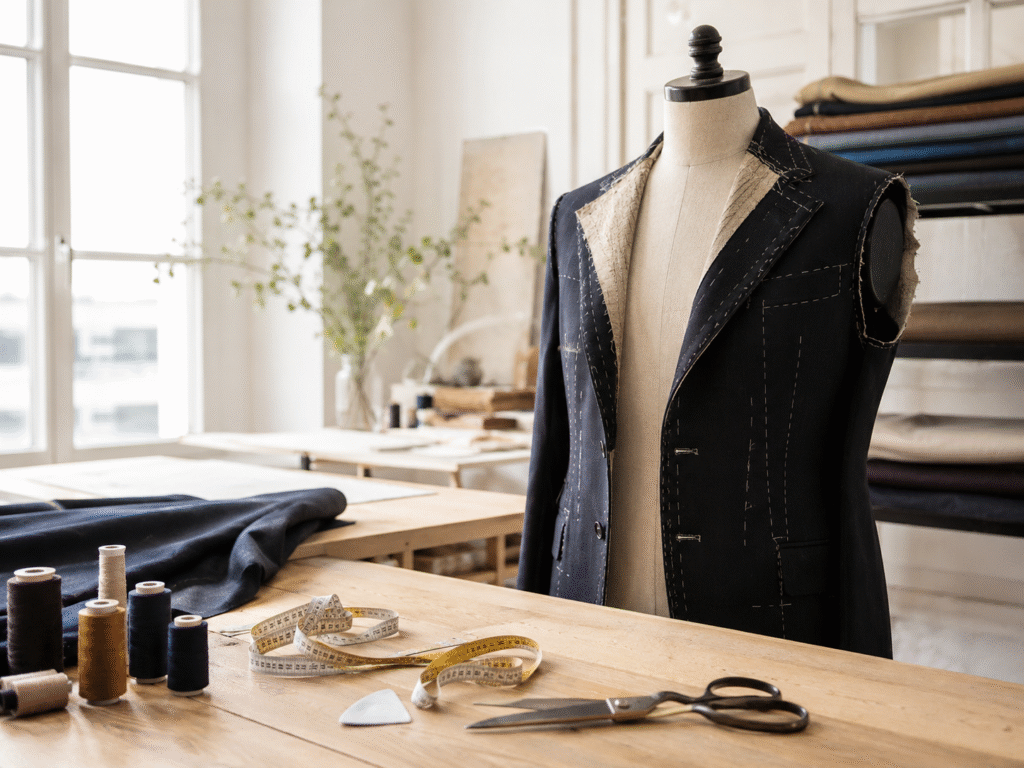
A tailoring shop is a labor-constrained business where profit is decided by service mix, revenue per tailor-hour, and capacity utilization, not by walk-in count.
The model works when the pricing ladder, material discipline, and skilled hands are engineered together, because tailor labor is structurally the dominant cost and alteration tickets are structurally the dominant revenue line.
The trap is volume of cheap work: a shop drowning in low-value hems can run flat out and still miss its margin.
The numbers below model an established single shop in an affluent suburban or urban-adjacent market, the segment best able to convert craftsmanship into pricing power as demand for fit and garment longevity grows.
Asset-Konfiguration
The economic question is not “how many machines can the floor hold,” it is “how many billable tailor-hours can the shop sell, and at what average value.”
Tailoring carries low capital intensity for a storefront, so the binding constraint is rarely equipment cash; it is the supply of skilled hours and the price each one commands.
| Asset category | Lean alterations shop (USD) | Full tailoring atelier (USD) | What drives the number |
| Industrial machines (straight, serger, blindstitch) | 5,000 to 12,000 | 15,000 to 40,000 | Stations and specialty machines |
| Pressing equipment (press, irons, boiler) | 2,000 to 6,000 | 6,000 to 18,000 | Finishing quality and throughput |
| Cutting tables, dress forms, fitting mirrors | 2,000 to 6,000 | 6,000 to 20,000 | Bespoke capability |
| Shop fit-out, fitting rooms, counter | 8,000 to 20,000 | 25,000 to 80,000 | Lease condition, brand positioning |
| Opening inventory (thread, zippers, linings, fabric) | 2,000 to 6,000 | 8,000 to 25,000 | Custom and fabric-sales breadth |
| POS, signage, licensing, deposits | 3,000 to 8,000 | 8,000 to 25,000 | Location and jurisdiction |
A lean shop opens for roughly 22,000 to 58,000 and a full atelier for 68,000 to 208,000, modest against most retail formats. Because the asset base is cheap, tailor-hour economics, not floor space, are the key stress test.
Formula: Revenue per tailor-hour = total revenue / annual billable tailor-hours
Example: 360,000 / 5,355 = 67.23 per tailor-hour
Against a fully loaded cost near 60 per tailor-hour, the spread is thin, which is precisely why service mix and utilization decide profitability.
Erlösmodell
Alteration and custom services are the engine, commonly 85% or more of total revenue, with express fees, retail, and B2B contracts as the lift.
Pricing follows a clear ladder: basic alterations such as hems and sleeves run 15 to 30, complex work such as suit restructuring and gown or bridal resizing runs 75 to 150, and custom or bespoke garments run 150 to 400 and beyond.
Core formulas:
Billable tailor-hours = tailors × productive hours × days × utilization
Annual tickets = billable tailor-hours / average hours per ticket
Blended ticket = Σ(tier share × tier price)
Worked example for the single shop, assuming three tailors, seven productive hours, 300 days, and 85% utilization:
Billable tailor-hours = 3 × 7 × 300 × 0.85 = 5,355
| Service tier | Share of tickets | Avg price (USD) | Avg tailor-hours |
| Basic alterations (hems, sleeves, take-ins) | 55% | 28 | 0.5 |
| Complex alterations (suits, gowns, bridal) | 30% | 88 | 1.5 |
| Custom and bespoke (shirts, garments) | 15% | 280 | 5.0 |
Average hours per ticket = (0.55 × 0.5) + (0.30 × 1.5) + (0.15 × 5.0) = 1.475
Annual tickets = 5,355 / 1.475 = 3,630
Blended ticket = (0.55 × 28) + (0.30 × 88) + (0.15 × 280) = 83.80
Service revenue = 3,630 × 84 = 304,000
| Revenue stream | Annahme | Annual revenue (USD) |
| Alteration and custom services | 3,630 tickets × 84 blended | 304,000 |
| Express surcharges | ~15% of tickets at +30% | 14,000 |
| Retail (fabric, notions, accessories) | counter attach | 12,000 |
| Corporate and B2B (uniforms, bridal parties) | contract demand | 30,000 |
| Gesamt | 360,000 |
Effective revenue per ticket, all-in, is 360,000 / 3,630 = 99, the number that shows how heavily a few bespoke jobs carry the blended figure above the hems.
Betriebskosten
Tailoring is a labor business with low materials. Skilled wages are the dominant line and rising, while fabric and notions stay small, so the profit levers sit in mix and utilization rather than cost-cutting. The hidden risk is time variance: a 35 alteration that swings from 30 to 90 minutes can turn gross-margin-negative at a 40 per hour labor cost.
Start with the labor build.
Productive tailors = master tailor + two tailors
Now cost the full operation.
| Cost category | Annual cost (USD) | Hinweise |
| Labor (master tailor, two tailors, counter, burden) | 198,000 | Dominant line, includes owner wage |
| Materials and supplies (thread, zippers, linings, fabric) | 40,000 | About 11% of revenue |
| Mieten | 30,000 | Roughly 2,500 per month |
| Marketing | 12,000 | Local search, referrals, social proof |
| G&A, supplies, contingency | 11,000 | Discipline matters |
| Software and card processing | 10,000 | POS plus ~2.7% on non-cash sales |
| Dienstprogramme | 7,000 | Power, steam, lighting |
| Equipment maintenance, needles, parts | 6,000 | Machine uptime |
| Insurance and licensing | 6,000 | Risk and compliance |
| Total operating costs | 320,000 |
Profit math:
Operating surplus = Total revenue − Total operating costs
Operating surplus = 360,000 − 320,000 = 40,000
Operating margin = 40,000 / 360,000 = 11.1%
Because the owner wage already sits inside labor, that surplus is profit on top of compensation, so the owner’s total take lands near 110,000. A healthy shop targets a 15% to 25% net margin, and the gap from 11% is closed by mix shift, express capture, and tighter utilization rather than by trimming overhead.
Break-even is where the thin margin of safety becomes visible.
Variable cost per ticket = materials per ticket + processing per ticket = 11.00 + 2.20 = 13.20
Contribution per ticket = effective revenue per ticket − variable cost per ticket = 99 − 13 = 86
Break-even tickets = Fixed costs / contribution per ticket
With fixed costs of about 273,000 (labor, rent, utilities, maintenance, marketing, insurance, core software, G&A):
Break-even tickets = 273,000 / 86 = 3,174 per year, or about 11 per day
Against 3,630 tickets, the shop clears break-even at roughly 87% of current volume. Expressed in capacity, that is about 74% tailor-hour utilization, so any sustained slide below three-quarters utilization tips the shop into loss. This is why revenue per tailor-hour, not ticket count, is the number to govern hiring and pricing.
Rentabilitätsstrategien
These levers only work once the model is aligned: a real catchment of fit-conscious clients, tailors whose hours are fully booked, and a ladder that prices skill honestly.
The goal is to widen the spread between revenue per tailor-hour and fully loaded cost per tailor-hour, then defend it as wages rise.
1. Shift the mix toward complex and custom work
The single largest lever is average order value, because a 280 bespoke job is worth ten basic hems and carries a higher margin per hour.
Move ten points of volume out of basic alterations into complex and custom tiers, and price bespoke for the skill it demands rather than anchoring to local hem rates.
Every point of mix shift compounds, since the constraint is hours and high-value hours pay for the same overhead far faster.
2. Manage revenue per tailor-hour, not ticket count
Track billable hours against revenue for each tailor, because a skilled craftsperson waiting between low-value jobs is the most expensive idle asset in the shop.
Hold utilization near 85%, route intake and quoting to a counter lead, and time-stress your prices so that a job whose true labor runs 90 minutes is never sold as a 30-minute ticket. The discipline is simple: no skilled hour leaves the shop underpriced.
3. Price tiers and express to capture urgency
A clear three-tier menu with a published price list converts more browsers and lets clients self-select into the value they want.
Layer a 25% to 50% express surcharge for 24 to 48 hour turnaround, since a meaningful share of bridal, interview, and event clients will pay for speed and that fee drops almost entirely to contribution.
Bundle event work, such as a bridal-party package, into a flat fee that secures multiple garments in one booking.
4. Lock recurring B2B and event demand
Consumer alterations are episodic, so build demand that repeats and books ahead. Pursue corporate uniform contracts, which can run 5,000 to 10,000 a year per client, alongside relationships with bridal boutiques, menswear retailers, and dry cleaners that feed steady referral volume.
Contracted and event-driven work smooths the schedule and lifts utilization in the weeks that walk-ins alone would leave thin.
5. Run material and workflow discipline
Materials are small per job but compound across thousands of tickets, so buy thread, zippers, and linings on volume terms and control fabric waste on high-value cuts.
Batch similar operations to cut setup time, standardize finishing steps to hold a low rework rate, and shave card processing toward the low end of its range, since on non-cash sales near 80% of revenue that recovers thousands annually with no change to the work.
Na und?
A tailoring shop can deliver a solid owner income and durable profit in a growing market, but only when it is run as a tailor-hour business rather than a hem-counting trade.
The practical path is to shift the mix toward complex and custom work, keep skilled hours fully booked and honestly priced, and stack express fees and B2B contracts on top of core alterations, then hold a 15% to 25% net margin that funds equipment and craft.
The operators who win manage revenue per tailor-hour against fully loaded cost per tailor-hour, job by job.

If you want to estimate revenue, costs, and profit using real inputs (tickets per day, service mix, average order value, labor, rent, and expenses), use a Finanzmodell einer Schneiderei to run the numbers fast.
