


Finanzmodelle
How Much Does a Driving School Business Make?

A driving school is a vehicle-intensive, instructor-constrained business where profitability hinges on utilization rate per car, instructor productivity, and geographic density of demand.
The unit economics are straightforward: revenue is generated per lesson hour, costs are dominated by vehicle depreciation, fuel, insurance, and instructor wages, and margin is created by maximizing booked hours against a fixed asset base.
Schools that treat scheduling discipline and fleet management as core competencies outperform those that compete on price alone.
Asset-Konfiguration
The central capital question in a driving school is fleet size relative to demand. Each vehicle represents a fixed cost block (depreciation, insurance, maintenance) that must be covered by booked lesson hours.
Overbuilding the fleet before demand is proven destroys early margins. A lean launch with 3 to 5 dual-control vehicles and a modest classroom or virtual setup is the disciplined path.
| Anlagekategorie | Lean Launch (USD) | Full Build (USD) | Key Driver |
| Dual-control vehicles (3 to 5 units) | 75.000 bis 150.000 | 150.000 bis 300.000 | New vs. certified pre-owned, fleet size |
| Vehicle branding and signage | 1,500 to 4,000 | 3,000 to 8,000 | Wrap vs. magnetic, number of units |
| Classroom or training space fit-out | 5,000 to 15,000 | 20,000 to 60,000 | Lease vs. owned, AV equipment |
| Driving simulator (optional) | 0 | 15,000 to 50,000 | Regulatory requirement or premium positioning |
| Scheduling and CRM software | 1,000 to 3,000 | 5,000 to 12,000 | Off-the-shelf vs. custom build |
| Licensing, permits, insurance setup | 8,000 to 20,000 | 15,000 to 35,000 | State requirements, coverage limits |
| Gesamt | 90,500 to 192,000 | 208,000 to 465,000 |
The stress test is vehicle cost per billable hour. If a $30,000 vehicle is depreciated over 4 years and drives 1,200 billable hours per year, the depreciation cost per hour is $6.25.
Add insurance at roughly $3,000 per vehicle per year ($2.50/hour), fuel at $4.00/hour, and maintenance at $1.50/hour, and the fully loaded vehicle cost per billable hour is approximately $14.25. Every unbilled hour inflates this number.
Formel: Vehicle cost per billable hour = (Annual depreciation + insurance + fuel + maintenance) / annual billable hours
Beispiel: ($7,500 + $3,000 + $4,800 + $1,800) / 1,200 = $14.25 per hour
Erlösmodell

Driving schools generate revenue through a combination of structured course packages and individual lesson hours. The typical US market prices behind-the-wheel instruction between $50 and $100 per hour depending on geography and competitive density.
Package pricing (bundling classroom hours with behind-the-wheel sessions) is the primary revenue format, with individual top-up lessons as a secondary stream.
Core Formulas
Gross lesson revenue = Total students x Average package price
Hourly capacity revenue = Fleet size x Billable hours per vehicle per day x Operating days x Average hourly rate
Total revenue = Package revenue + Individual lessons + Add-on services
Worked example for a mid-market school with 5 vehicles, operating 6 days per week in a suburban US market:
| Einnahmequelle | Annahme | Jahresumsatz (USD) |
| Package courses (teen) | 180 students x $450 avg package | 81,000 |
| Package courses (adult) | 120 students x $550 avg package | 66,000 |
| Individual behind-the-wheel lessons | 1,800 hours x $65/hour | 117,000 |
| Road test preparation sessions | 200 sessions x $95 | 19,000 |
| Defensive driving / insurance discount courses | 100 enrollees x $40 | 4,000 |
| Online classroom (if state-approved) | 150 enrollees x $60 | 9,000 |
| Gesamtumsatz | 296,000 |
The revenue ceiling is set by fleet utilization. With 5 vehicles operating an average of 6 billable hours per day across 300 operating days, maximum capacity is 9,000 hours.
At $65 average blended rate, theoretical maximum revenue is $585,000. The worked example above implies a blended utilization of roughly 55%, which is realistic for a school in its first two to three years.
Betriebskosten

Driving schools are instructor-cost businesses layered on top of vehicle-cost businesses. Instructor compensation typically represents 40% to 55% of revenue, and total vehicle costs (depreciation, insurance, fuel, maintenance) add another 15% to 25%. The remaining overhead covers rent, marketing, administrative staff, and software.
Instructor Staffing Math
Instructor FTE = Total annual billable hours / Hours per instructor per year
If total billable demand is 4,800 hours per year and each instructor works 1,200 billable hours (accounting for breaks, no-shows, and admin time out of a 1,600 total hour year), the school needs 4 full-time instructors.
Beispiel: 4,800 / 1,200 = 4 FTE instructors
| Kostenkategorie | Jährliche Kosten (USD) | Hinweise |
| Instructor wages and benefits | 144,000 | 4 FTE at $36,000 avg (mix of salary and per-hour) |
| Vehicle depreciation | 37,500 | 5 vehicles at $30,000, 4-year straight-line |
| Vehicle insurance | 18,000 | Commercial auto, $3,600 per vehicle avg |
| Fuel | 14,400 | 4,800 hours x approx $3.00/hour blended |
| Vehicle maintenance and repairs | 9,000 | $1,800 per vehicle per year |
| Office or classroom lease | 18,000 | $1,500/month, suburban location |
| Marketing (digital, referral, local) | 14,000 | Google Ads, social, referral incentives |
| Software and scheduling tools | 3,600 | CRM, booking platform, accounting |
| Admin staff | 28,000 | 1 part-time front desk, bookkeeping |
| Licensing and compliance | 4,000 | State renewals, instructor certifications |
| Gesamtbetriebskosten | 290,500 |
Profit Calculation
- Operating Profit = Total Revenue – Total Operating Costs
- Operating Profit = $296,000 – $290,500 = $5,500
- Operating Margin = Operating Profit / Total Revenue
- Operating Margin = $5,500 / $296,000 = 1.9%
A 1.9% margin on a mid-market school at 55% utilization is thin but not unusual for early-stage operations. The critical insight: margin expansion comes almost entirely from pushing utilization toward 70% to 80% without proportional increases in fixed cost.
At 75% utilization (6,750 billable hours), revenue climbs to approximately $438,750 while fixed costs remain largely unchanged, yielding a projected margin closer to 12% to 15%.
Break-Even-Analyse
Break-even hours = Fixed costs / (Average hourly rate – Variable cost per hour)
If fixed costs (lease, admin, software, licensing, depreciation) total $91,100 per year, the average blended rate is $65 per hour, and variable costs per hour (instructor pay at $12/hour of instruction, fuel at $3.00, maintenance at $1.50) total $16.50:
Break-even hours = $91,100 / ($65.00 – $16.50) = $91,100 / $48.50 = 1,878 hours per year
With 5 vehicles and 300 operating days, 1,878 hours translates to roughly 1.25 billable hours per vehicle per day. Any school that cannot fill 1.25 hours per car per day has a demand problem, not a cost problem.
Rentabilitätsstrategien
Profitability strategies only matter once the operating model is sound. From here, the goal is to widen the spread between revenue per hour and cost per hour, then scale it through utilization.
Utilization is the only margin lever that scales
Fixed costs in a driving school (fleet, insurance, lease, admin) do not move with volume. Every incremental billable hour above break-even drops almost entirely to the bottom line, net of instructor pay and fuel.
The strategic priority is scheduling density: minimize gaps between lessons, reduce no-shows through prepayment policies and automated reminders, and stagger instructor shifts to cover morning, afternoon, and evening demand windows.
Price architecture over discounting
Resist the impulse to compete on sticker price. Instead, build tiered packages that bundle classroom, behind-the-wheel, and road test preparation at ascending price points.
A three-tier structure (basic at $399, standard at $549, premium at $749) anchors buyer perception and shifts the mix toward higher-margin bundles.
Premium tiers should include add-ons with near-zero marginal cost, such as online classroom access, scheduling priority, or a guaranteed road test slot.
Fleet discipline over fleet growth
Do not add a sixth vehicle until the existing five are consistently above 70% utilization. Each incremental vehicle adds roughly $15,800 in annual fixed cost (depreciation plus insurance plus maintenance).
At $48.50 contribution margin per hour, that vehicle must generate at least 326 incremental billable hours per year, or roughly 1.1 hours per operating day, just to break even on its own cost. Prove demand before adding capacity.
Instructor economics as a retention tool
High instructor turnover destroys scheduling consistency and student satisfaction. Structure compensation with a base plus per-lesson bonus that rewards utilization.
An instructor paid $15/hour base plus $3 per completed lesson hour earns more as the school fills capacity, aligning incentives.
Retention also reduces recruiting and training costs, which are often underestimated at $2,000 to $4,000 per new instructor hire.
Geographic density over geographic spread
Dead miles between student pickups and drop-offs are unbillable. Concentrate marketing spend within a tight radius (10 to 15 miles from the base) and build route density before expanding coverage.
A school with 80% of students within 10 miles will achieve 15% to 20% more billable hours per vehicle than one spread across 30 miles, simply through reduced transit time between lessons.
Na und?
A driving school generates attractive returns only when fleet utilization, instructor productivity, and pricing discipline are managed as an integrated system.
The math is unforgiving at low utilization and generous at high utilization, which means the difference between a 2% margin and a 15% margin is often just 20 additional billable hours per vehicle per month.
Operators who treat scheduling as their core competency and resist premature fleet expansion will consistently outperform those who chase volume through price cuts or geographic sprawl.

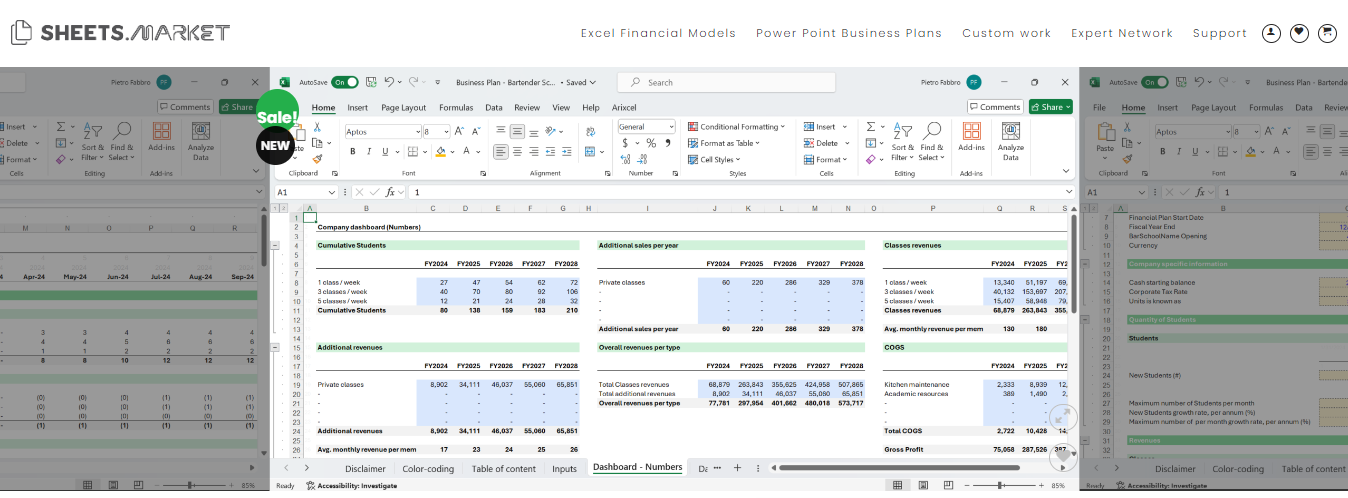
If you want to model revenue, costs, and profit using your own inputs (fleet size, hourly rate, instructor count, and utilization targets), use this template to run the numbers: Get the Driving School Financial Model.
