


Бизнес-планирование и стратегия
How Much Money Does a Photo Booth Business Make?

A photo booth business is a low fixed cost, high variable margin model where profitability is governed by booking density, average event price, and asset utilization rate rather than by volume of inquiries.
The model works when capital is deployed into equipment that books frequently, pricing captures the full willingness to pay per event, and labor scales only when an event is confirmed, because equipment sits idle most days and revenue concentrates on weekends and seasonal peaks.
Конфигурация активов
The economic question is not “how many booths do I own,” it is “what is my annual revenue per booth relative to its total cost of ownership.”
A single booth that books 120 events per year at strong margins outperforms three booths booking 30 events each with higher transport and labor overhead.
Capital outlay depends on booth type, print quality, and prop inventory. The range is wide because a mirror booth or 360 booth commands higher per-event pricing but carries a higher upfront cost.
| Asset category | Entry setup (USD) | Premium multi-booth setup (USD) | What drives the number |
|---|---|---|---|
| Booth hardware (enclosure, camera, lighting, printer) | от 3000 до 7000 | 15,000 to 40,000 | Booth type: open air, enclosed, mirror, 360 |
| Software and licensing | 500 to 1,500 | 1,500 to 4,000 | White-label branding, GIF/video, gallery hosting |
| Props, backdrops, signage | 300 to 1,000 | 1,500 to 5,000 | Inventory depth and replacement cycle |
| Transport vehicle or trailer | 0 to 5,000 | 5,000 to 25,000 | Van lease vs dedicated trailer build-out |
| Website, CRM, booking system | 500 to 2,000 | 2000–5000 | Automation level and lead capture |
| Insurance, permits, legal setup | 500 to 1,500 | 1,500 to 4,000 | Liability coverage and jurisdiction |
| Общие капитальные затраты | 4,800 to 18,000 | 26,500 to 83,000 |
Cost per event is the key stress test.
Формула: Annual equipment cost per event = (Depreciation + maintenance + software) / Total events booked
Пример: (6,000 annual cost / 100 events) = $60 equipment cost per event
A booth depreciating over 3 years at $9,000 purchase price carries $3,000 per year in depreciation alone. If it books only 50 events, that is $60 per event in depreciation. At 120 events, it drops to $25. Utilization is the margin lever.
Модель дохода
Photo booth revenue is event-based, with pricing determined by duration, booth type, add-ons, and market segment. The core formula is simple, but the revenue ceiling depends on how well the operator builds packages and captures upsell.
Core formulas:
Gross event revenue = Number of events x Average package price
Annual revenue = (Weekend events x Avg weekend price) + (Weekday/corporate events x Avg corporate price) + Digital upsells
Worked example for a single-booth operator in a mid-tier US market:
Assume 100 events per year (roughly 2 per week during peak season, 1 per week off-season), with a blended average package price of $850.
Gross revenue = 100 x $850 = $85,000
Now layer in revenue diversification:
| Revenue stream | Предположение | Annual revenue (USD) |
|---|---|---|
| Wedding and private event packages | 50 events x $1,000 | 50,000 |
| Corporate event packages | 25 events x $900 | 22,500 |
| School, prom, community events | 15 events x $600 | 9,000 |
| Digital add-ons (GIF walls, galleries, branding) | 60 events x $150 upsell | 9,000 |
| Print upsells and guest books | 40 events x $100 | 4,000 |
| Off-peak mini sessions or activations | 10 x $500 | 5,000 |
| Общий | 99,500 |
The wedding segment commands premium pricing because couples budget $500 to $1,500 for photo entertainment, and corporate clients pay for branding integration.
A two-booth operator serving 180 to 220 events annually can push revenue to $150,000 to $200,000 before adding a third unit.
Revenue per booth per year is the metric that matters. Industry benchmarks for active single-booth operators range from $50,000 to $120,000 depending on market density and pricing discipline.
Эксплуатационные расходы
Photo booth businesses are equipment and labor businesses with relatively lean overhead. Unlike brick-and-mortar operations, there is no rent in the traditional sense, but transport, labor, and marketing replace it as the dominant variable cost lines.
Per-event cost model:
| Cost item | Per-event cost (USD) | Примечания |
|---|---|---|
| Attendant labor | 100 to 200 | 3 to 5 hours at $25 to $40/hr loaded |
| Transport (fuel, mileage, tolls) | 30 to 80 | Radius and vehicle type |
| Print supplies (paper, ink, ribbons) | 15 to 40 | Volume dependent |
| Props and consumables | 10 to 25 | Replacement rate |
| Variable cost per event | 155 to 345 |
Annual fixed cost structure (single-booth operator):
| Cost category | Annual cost (USD) | Примечания |
|---|---|---|
| Equipment depreciation and maintenance | 4000–6000 | 3-year depreciation cycle |
| Подписки на программное обеспечение | 1,200 to 3,000 | Booking, gallery, editing tools |
| Страхование | 1000–2500 | General liability and equipment |
| Marketing (SEO, ads, vendor listings) | 3,000 to 8,000 | Lead generation engine |
| Vehicle costs (payment, insurance, maintenance) | 2,400 to 6,000 | If dedicated vehicle |
| Storage | 600 to 2,400 | If not home-based |
| Administrative (accounting, CRM, phone) | 1,200 to 2,500 | Back-office basics |
| Total annual fixed costs | 13,400 to 30,400 |
Profit math (100-event base case):
- Total revenue = $99,500
- Total variable costs = 100 events x $225 average = $22,500
- Total fixed costs = $20,000 (mid-range estimate)
- Operating profit = 99,500 – 22,500 – 20,000 = $57,000
- Operating margin = 57,000 / 99,500 = 57.3%
This margin profile is attractive relative to most service businesses, but it compresses quickly if booking volume drops.
Break-even analysis:
- Contribution per event = Average revenue per event – Variable cost per event
- Contribution per event = $995 – $225 = $770
- Break-even events = Fixed costs / Contribution per event
- Break-even events = $20,000 / $770 = 26 events
This means a single-booth operator reaches profitability after roughly 26 bookings. Every event beyond break-even contributes $770 toward profit. This is why booking density, not equipment quantity, is the primary growth lever.
Стратегии прибыльности
Profitability in this model comes from maximizing revenue per event, increasing booking density, and keeping variable costs disciplined. Equipment expansion should follow demand, never lead it.
Price architecture over discounting
Build tiered packages (2-hour base, 3-hour standard, 4-hour premium) with clear upsell paths. The goal is to move average package price upward through add-ons (custom overlays, video, digital galleries, guest books) rather than competing on base price. A $200 upsell on 60% of events adds $12,000 annually with near-zero marginal cost.
Weekend utilization is the constraint
Most photo booth revenue concentrates on Friday and Saturday nights. A 52-weekend year offers roughly 104 prime slots. Filling 70% to 80% of those slots is the realistic ceiling for a single booth. Weekday corporate events and brand activations fill the gap, but they require a separate sales channel and different pricing logic.
Labor as a variable cost, not a fixed one
Use trained part-time attendants paid per event rather than salaried employees. This keeps the cost structure flexible and tied directly to revenue. A reliable attendant pool of 3 to 5 people provides coverage without payroll commitment.
Marketing ROI over marketing spend
Wedding vendor platforms (The Knot, WeddingWire), Google Business Profile, and referral incentives deliver higher conversion per dollar than broad social media advertising. Track cost per booking, not impressions. A benchmark target is under $50 in marketing cost per booked event.
Scale through utilization before fleet expansion
Add a second booth only when the first consistently books 90+ events per year and turns away business. A second booth doubles CapEx and transport complexity but does not double demand. The economics of booth two must stand on its own booking pipeline.
Ну и что?
A photo booth business can generate $50,000 to $100,000 in annual profit on a single well-utilized unit, with operating margins above 50% at healthy booking volumes. The model breaks even quickly (under 30 events) and scales favorably when expansion follows proven demand.
The practical path is to engineer maximum bookings per booth, build package pricing that captures upsell, and keep labor and transport as variable costs tied to confirmed events.
Operators who treat this as an asset utilization business rather than a creative hobby will consistently outperform.
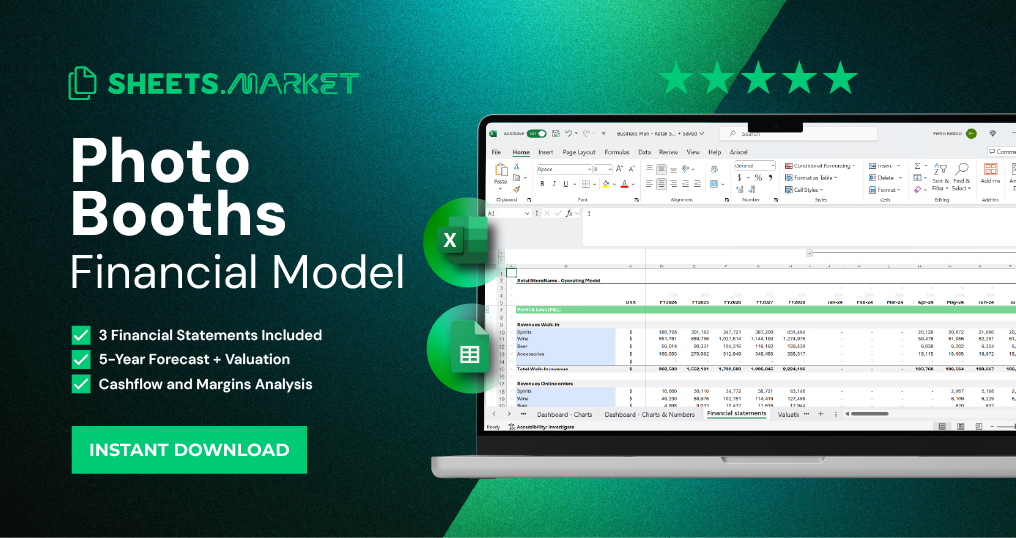
If you want to estimate revenue, costs, and profit using real inputs (event count, pricing, equipment costs, and labor), use this template to run the numbers fast: Get the Photo Booth Financial Model.
