


Modèles financiers
Combien d'argent gagne un studio de yoga ?

A yoga studio is a high fixed cost, low variable cost business where profitability is governed by three variables: class utilization rate, revenue per square foot, and instructor cost as a percentage of revenue.
The model works when pricing discipline, schedule density, and revenue diversification beyond group classes are engineered together, because rent is structurally the anchor cost line and group class revenue alone rarely covers it with margin to spare.
Configuration des actifs
The economic question is not “how beautiful is the studio,” it is “what annual facility cost per class can the revenue base support.”
A standard studio requires 1,200 to 2,000 square feet, accommodating 15 to 30 participants per class.
Design quality directly influences pricing power, but over-investment in build-out before demand is proven is the most common capital mistake in boutique fitness.
| Catégorie d'actifs | Lean Launch (USD) | Full Build (USD) | Key Driver |
| Studio build-out (flooring, mirrors, lighting, HVAC) | 35,000 to 65,000 | 80,000 to 120,000 | Heated formats require upgraded HVAC |
| Sound and heating systems | 5,000 to 12,000 | 15 000 à 25 000 | Bikram or hot yoga requirement |
| Reception and admin area | 4,000 to 8,000 | 10 000 à 15 000 | POS, check-in kiosk, retail display |
| Yoga props and equipment | 1 000 à 2 000 | 2 000 à 4 000 | Mats, blocks, straps, bolsters |
| Branding and interior design | 3 000 à 7 000 | 8 000 à 15 000 | Directly influences price premium |
| Software, booking, and CRM setup | 1 000 à 2 000 | 2,500 to 5,000 | Mindbody, Momoyoga, or equivalent |
| Licensing, permits, insurance | 3 000 à 6 000 | 6,000 to 12,000 | Jurisdiction and liability coverage |
| Total | 52,000 to 102,000 | 123,500 to 196,000 |
Facility cost per class is the stress test.
- Formule: Annual facility cost per class = (Rent + utilities + maintenance) / Total classes per year
- Exemple: ($96,000 + $14,400 + $7,200) / 1,300 classes = $90.46 per class
If average net revenue per class is $180 (15 attendees at $12 net per head after membership discounting), the facility cost consumes 50.3% of class revenue. That ratio must sit below 45% for the model to breathe.
Modèle de revenus

Revenue splits into two categories: recurring (memberships and packages) and transactional (drop-ins, privates, workshops, retail). The strongest studios derive 55% to 65% of revenue from recurring sources, which stabilize cash flow and reduce acquisition pressure.
Core Formulas
- Gross class revenue = Classes per week x Average attendance x Net revenue per visit x 52 weeks
- Membership revenue = Active members x Average monthly rate x 12
- Total revenue = Class revenue + Membership revenue + Privates + Training + Retail + Workshops
Worked example for a 1,500 sq. ft. urban studio operating 25 classes per week:
| Flux de revenus | Hypothèse | Chiffre d'affaires annuel (USD) |
| Memberships (unlimited and tiered) | 120 members x $145 avg/month | 208,800 |
| Class packages and drop-ins | 600 visits/month x $18 net avg | 129,600 |
| Private sessions | 8 sessions/week x $100 x 50 weeks | 40,000 |
| Teacher training programs | 12 students x 2 cycles/year x $3,000 | 72,000 |
| Workshops and events | 2/month x $800 avg net | 19,200 |
| Retail (apparel, props, accessories) | $450/week avg | 23,400 |
| Revenu total | 493,000 |
Revenue per square foot is the benchmark that matters. In this example: $493,000 / 1,500 = $328.67 per sq. ft. per year. Well-performing boutique fitness studios target $300 to $450 per square foot. Studios relying only on group classes typically cap at $180 to $250 per square foot with volatile cash flow.
Coûts d'exploitation
Yoga studios are rent-and-labor businesses. Rent typically represents 20% to 30% of revenue, and instructor costs add another 25% to 35%.
The key structural decision is whether instructors are paid flat per class or on a revenue-share model. Revenue-share aligns cost with demand and protects margin during slow periods.
Instructor Staffing Math
Instructor cost per class = Flat rate per class OR (Per-head rate x Average attendance)
If 25 classes per week are taught at $75 flat per class: 25 x $75 x 52 = $97,500 per year. If the same classes are paid at $5 per attending student and average attendance is 15: 25 x ($5 x 15) x 52 = $97,500.
The numbers converge at 15 students, but the per-head model protects the studio when attendance drops below that threshold.
| Catégorie de coût | Coût annuel (USD) | Notes |
| Instructor payments | 97,500 | 25 classes/week at $75 avg per class |
| Rent and lease | 96,000 | $8,000/month, urban location |
| Utilities (electric, water, HVAC) | 14,400 | Higher for heated formats |
| Marketing and customer acquisition | 30,000 | Digital, referral programs, intro offers |
| Studio manager (1 FT) | 42,000 | Front desk, scheduling, member relations |
| Software and subscriptions | 8,400 | Booking, CRM, payment processing |
| Insurance and legal | 9,600 | Liability, property, workers comp |
| Supplies and maintenance | 7,200 | Props replacement, cleaning, repairs |
| Coûts d'exploitation totaux | 305,100 |
Profit Calculation
Operating Profit = Total Revenue – Total Operating Costs
Operating Profit = $493,000 – $305,100 = $187,900
Operating Margin = Operating Profit / Total Revenue
Operating Margin = $187,900 / $493,000 = 38.1%
A 38% margin represents a well-diversified studio with strong teacher training and private session revenue. Studios without those high-margin lines typically operate at 10% to 18% margins.
Analyse du seuil de rentabilité
Break-even monthly revenue = Total fixed costs per month / Contribution margin ratio
Fixed costs (rent, manager, insurance, software, base maintenance): $14,350 per month. Variable costs per class (instructor pay, supplies): roughly $78 per class. If average net revenue per class is $180:
Contribution margin per class = $180 – $78 = $102
Contribution margin ratio = $102 / $180 = 56.7%
Break-even monthly revenue = $14,350 / 0.567 = $25,310 per month
At $493,000 annual revenue ($41,083/month), the studio sits comfortably above break-even. But a group-class-only studio generating $250,000 annually ($20,833/month) would operate dangerously close to or below the line.
Stratégies de rentabilité

Profitability strategies only matter once the operating model is sound: rent is sized to revenue capacity, instructors are paid variably, and recurring membership revenue covers at least 60% of fixed costs.
Schedule density is the primary margin lever
Every empty mat in a class is lost revenue against fixed rent. Track attendance by day, time, and instructor over 90-day windows. Cut classes averaging below 40% capacity and double down on slots above 70%. A studio running 25 classes at 60% fill outperforms one running 35 classes at 35% fill because instructor cost is avoided on eliminated sessions while rent stays constant.
Build revenue layers that do not require mat space
Teacher training programs, online content subscriptions, and branded retail generate revenue without consuming class capacity. A 200-hour teacher training at $3,000 per student with 12 participants generates $36,000 per cycle at near-zero incremental facility cost. Two cycles per year add $72,000 in high-margin revenue, enough to shift a studio from 12% margin to 25%+.
Membership architecture over discounting
Drop-in pricing should be the most expensive option, creating an economic incentive to commit. Structure three tiers: 4x/month at $79, 8x/month at $119, and unlimited at $159. The unlimited tier delivers the highest lifetime value and lowest churn. Never use aggregator platforms (Groupon, ClassPass at deep discount tiers) as primary acquisition channels, because they attract price-sensitive users with churn rates above 80%.
Control instructor cost structurally
Shift from flat per-class rates to a hybrid model: a lower base ($40 to $50 per class) plus a per-head bonus ($2 to $3 per student above a threshold of 10). This aligns instructor incentives with studio economics and protects margin on low-attendance slots without cutting schedules entirely.
Treat retail and workshops as margin amplifiers
Retail margins on branded yoga apparel and accessories run 50% to 65%. At $450 per week, the studio captures $12,000 to $15,000 in gross profit annually with minimal labor. Workshops priced at $40 to $75 per head generate incremental revenue on otherwise empty weekend slots.
Et alors ?
A yoga studio generates strong cash flow when managed as a capacity utilization business with layered revenue streams, not as a class schedule with a lease attached.
The practical path is to size rent to realistic demand, pay instructors variably, build recurring membership revenue to cover fixed costs, and layer high-margin programs (training, privates, retail) on top.
Studios that execute this model target 25% to 40% operating margins on sub-$200,000 initial investment.

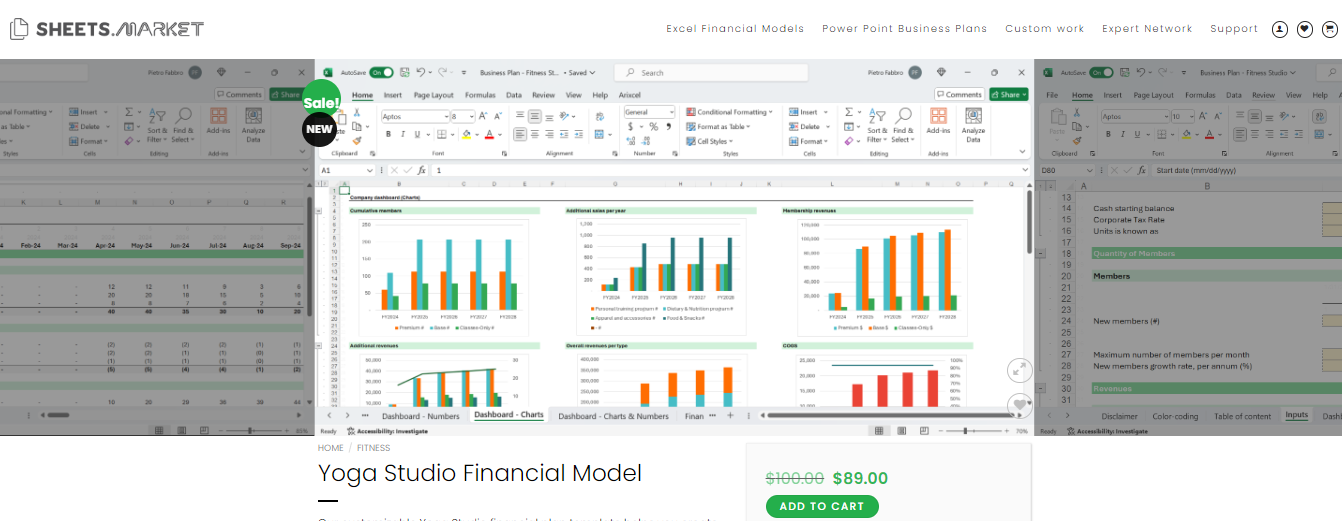
If you want to estimate revenue, costs, and profit using real inputs (class schedule, membership tiers, instructor pay, and rent), use this template to run the numbers fast: Get the Yoga Studio Financial Model.
