


Geschäftsplanung und -strategie
How Much Money Does an Automated Kiosk Business Make?

An automated kiosk business is a capital-light, labor-minimal model where profitability is determined by location economics, transaction volume per unit, and product margin rather than by headcount or square footage.
The model works when each kiosk generates enough daily revenue to clear its rent, COGS, and servicing cost with a meaningful surplus, because the entire value proposition rests on replacing labor with automation and replacing storefronts with high-traffic micro-footprints.
Small shifts in placement quality or product mix move profit more than fleet size does.
Asset-Konfiguration
The economic question is not “how many kiosks can I deploy,” it is “what is my monthly contribution margin per deployed unit after rent and servicing.”
A single kiosk in a high-traffic airport corridor will outperform five units in low-traffic strip malls because fixed placement costs do not scale down with volume.
Capital requirements vary sharply by kiosk type. A simple vending unit costs a fraction of a custom interactive retail kiosk with digital screens and payment integration.
| Asset category | Basic vending kiosk (USD) | Custom interactive kiosk (USD) | What drives the number |
| Kiosk hardware (unit, refrigeration, dispenser) | 3,000 to 8,000 | 15,000 to 50,000 | Product type: snacks, electronics, beauty, food |
| Payment system (card reader, NFC, mobile) | 300 to 800 | 1,000 to 3,000 | Cashless-only vs multi-payment integration |
| Software (inventory, remote monitoring, analytics) | 500 to 2,000 | 2,000 to 8,000 | Real-time telemetry and dynamic pricing |
| Installation, permits, electrical setup | 500 to 2,000 | 2,000 to 6,000 | Location requirements and code compliance |
| Branding, wraps, signage | 200 to 800 | 1,500 to 5,000 | Custom design vs standard shell |
| Insurance and legal entity setup | 500 to 1,500 | 1,500 to 4,000 | Liability and jurisdictional requirements |
| Total CapEx per unit | 5,000 to 15,100 | 23,000 to 76,000 |
Cost per transaction is the stress test that governs unit economics.
- Formel: Monthly fixed cost per kiosk = (Depreciation + rent + servicing + software) / 30
- Beispiel: ($833 depreciation + $1,200 rent + $400 servicing + $150 software) / 30 = $86 per day in fixed costs
If the kiosk averages 40 transactions per day at $4.50 average ticket, daily gross revenue is $180. At 50% product margin, gross profit is $90, which clears the $86 daily fixed cost by $4. That is a breakeven unit.
Push transactions to 60 per day and the math changes entirely: $270 gross revenue, $135 gross profit, $49 daily surplus, translating to roughly $1,470 monthly profit per kiosk.
Erlösmodell
Kiosk revenue is a volume game measured in transactions per day per unit. The core economics are transaction count multiplied by average ticket multiplied by product margin, repeated across every deployed unit.
Core formulas:
- Daily gross revenue per kiosk = Transactions per day x Average ticket price
- Monthly gross profit per kiosk = Daily gross revenue x Product margin % x 30
- Annual fleet revenue = Number of kiosks x Monthly gross revenue x 12
Worked example for a 10-kiosk snack and beverage operation:
- Assume 55 transactions per day per kiosk, average ticket $5.00, product margin 50%.
- Daily gross revenue per kiosk = 55 x $5.00 = $275
- Daily gross profit per kiosk = $275 x 0.50 = $137.50
- Monthly gross profit per kiosk = $137.50 x 30 = $4,125
| Revenue stream | Annahme | Annual revenue (USD) |
| Core product sales | 10 kiosks x $275/day x 365 | 1,003,750 |
| Premium placement upsell (airport, hospital) | 3 kiosks at $350/day x 365 | 82,125 additional |
| Digital screen advertising | 4 kiosks x $200/month | 9,600 |
| Data licensing and brand partnerships | Flat annual agreements | 5,000 |
| Gesamt | 1,100,475 |
Revenue per kiosk per month is the governing metric. Industry benchmarks for well-placed automated vending kiosks range from $3,000 to $10,000 in monthly gross revenue depending on product category, location tier, and traffic density.
Specialty kiosks (electronics, beauty, fresh food) command higher tickets but carry higher COGS and spoilage risk.
Betriebskosten
Automated kiosk businesses are location and COGS businesses with minimal labor. The cost structure inverts the typical retail model: there is no storefront lease in the traditional sense, but placement fees (revenue shares or flat monthly rents to property owners) replace it as the dominant fixed cost after product.
Per-kiosk monthly cost model:
| Cost item | Monthly cost per kiosk (USD) | Hinweise |
| Product COGS (50% margin assumed) | 4,125 | Dominant variable cost |
| Location rent or revenue share | 800 to 2,500 | 10% to 25% of revenue, or flat fee |
| Restocking labor (1 to 3 visits/week) | 200 to 500 | Route driver or contractor |
| Equipment depreciation | 400 to 1,200 | 3 to 5 year useful life |
| Software and connectivity | 100 to 300 | Monitoring, payments, analytics |
| Payment processing fees | 165 to 250 | 2% to 3% of gross revenue |
| Wartung und Reparaturen | 100 to 300 | Preventive plus reactive |
| Insurance (allocated per unit) | 80 to 150 | General liability and property |
| Total monthly cost per kiosk | 5,970 to 9,325 |
Annual fleet cost for 10 kiosks (mid-range estimates):
| Cost category | Annual cost (USD) | Hinweise |
| Product COGS | 495,000 | 50% of core product revenue |
| Location fees | 180,000 | Blended $1,500/month per unit |
| Restocking and route labor | 42,000 | Part-time route staff |
| Equipment depreciation | 84,000 | $700/month per unit average |
| Software, connectivity, processing | 36,000 | $300/month per unit |
| Wartung und Reparaturen | 24,000 | $200/month per unit |
| Versicherung | 14,400 | $120/month per unit |
| Marketing and customer acquisition | 12,000 | Location scouting, partnerships |
| Administrative overhead | 18,000 | Accounting, entity maintenance |
| Total annual operating costs | 905,400 |
Profit math:
- Operating profit = Total revenue – Total operating costs
- Operating profit = 1,100,475 – 905,400 = $195,075
- Operating margin = 195,075 / 1,100,475 = 17.7%
This margin is strong for an asset-light retail model, but it is highly sensitive to two variables: transaction volume and location cost.
Break-even per kiosk:
Break-even daily transactions = Monthly fixed costs / (Average ticket x Product margin % x 30)
Beispiel: $2,700 monthly fixed costs / ($5.00 x 0.50 x 30) = 36 transactions per day
Any kiosk averaging below 36 daily transactions is a cash drain. This number should govern every placement decision.
Rentabilitätsstrategien
Profitability in an automated kiosk business follows a simple rule: maximize revenue per unit before adding units, then replicate only the placement profile that works.
The strategies below target the three levers that matter most: location quality, product margin, and servicing efficiency.
Location selection as the primary profit lever
The difference between a profitable and unprofitable kiosk is almost always the location, not the product. Prioritize placements with guaranteed foot traffic: airports, hospitals, universities, transit hubs, and large corporate campuses.
Negotiate revenue-share agreements over flat rent when traffic is uncertain, and use flat rent when traffic is proven and the share would cost more. Track transactions per day per location weekly and relocate underperforming units within 90 days.
Product mix optimization for margin and velocity
Not all SKUs contribute equally. Use real-time sales data to rotate slow movers out and expand high-margin, high-velocity items.
The target is fewer SKUs with higher turnover, which reduces spoilage, simplifies restocking, and concentrates margin.
A kiosk carrying 20 optimized SKUs will outperform one carrying 40 with uneven demand because restocking cost per visit drops and sell-through rate rises.
Route density to compress servicing costs
Restocking is the hidden margin killer. If kiosks are scattered across a wide geography, route labor and fuel eat into per-unit profit.
Cluster deployments within tight geographic zones so a single route driver can service 8 to 12 kiosks in one shift.
The benchmark target is under $40 in total servicing cost per kiosk per visit. Remote inventory monitoring reduces unnecessary trips by triggering restocks only when fill rates drop below threshold.
Dynamic pricing and daypart strategy
Cashless, software-driven kiosks enable real-time price adjustments. Increase prices during peak demand windows (morning rush, lunch, late night) and offer modest discounts during dead hours to pull incremental volume.
Even a $0.25 average ticket increase across 55 daily transactions adds $5,000 per kiosk annually with zero incremental cost.
Fleet expansion governed by unit economics
Add kiosks only when existing units consistently exceed break-even by 40% or more and when a pipeline of qualified locations exists.
A second wave of 5 units should carry its own P&L projection. If average revenue per kiosk declines as the fleet grows, the expansion is dilutive, not accretive. Every new unit must be justified by its own projected contribution margin, not by fleet-level averaging.
Na und?
An automated kiosk business can generate $150,000 to $250,000 in annual operating profit on a 10-unit fleet, with margins in the 15% to 25% range when location selection and product mix are disciplined.
The model breaks even quickly at the unit level (under 40 transactions per day) and scales efficiently when expansion follows proven placement economics.
The practical path is to engineer unit-level profitability first, cluster deployments for route efficiency, and let transaction data govern every product and pricing decision.
Operators who treat each kiosk as an individual P&L rather than a fleet average will consistently outperform.
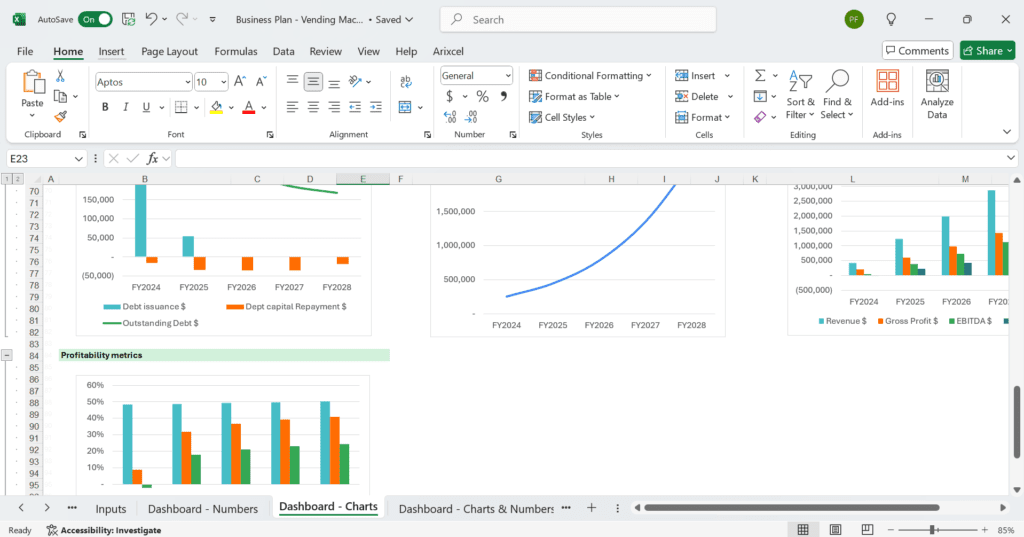
If you want to estimate revenue, costs, and profit using real inputs (kiosk count, transaction volume, product margins, and location fees), use this template to run the numbers fast: Get the Automated Kiosk Financial Model
