


Planification et stratégie d'entreprise
How Much Does a Massage Parlor Make?
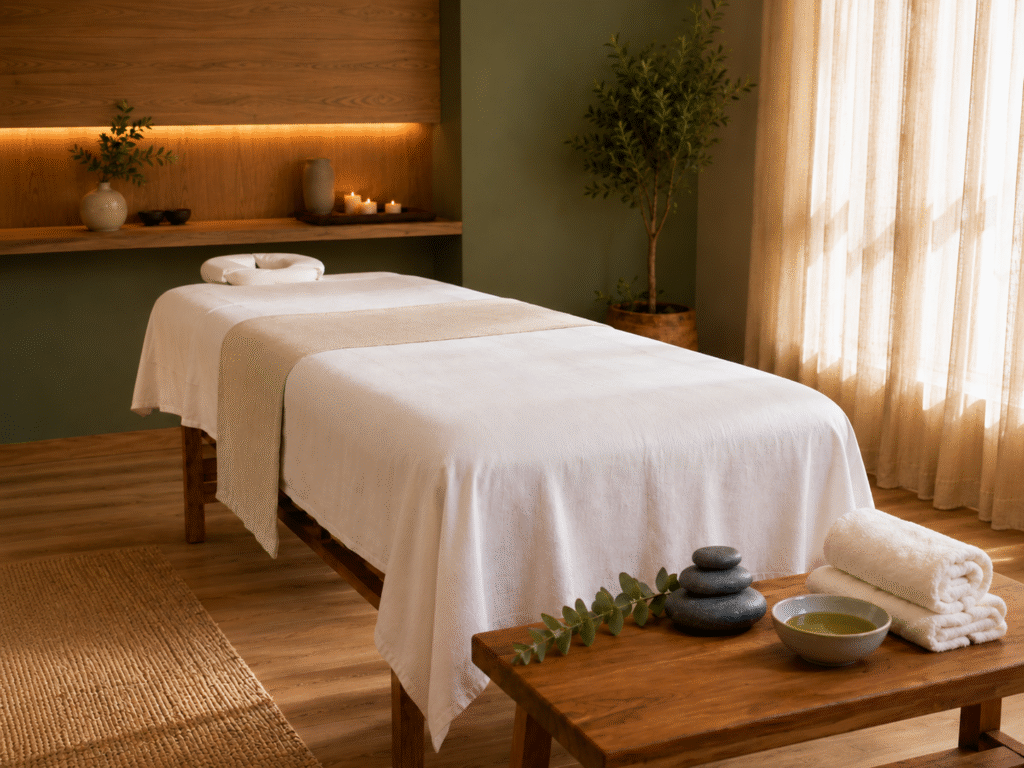
A massage business is a capacity business where profit is decided by room utilization, the therapist pay split, and average ticket, not by raw foot traffic.
The model works when pricing, scheduling, and labor cost are engineered together, because therapist compensation is structurally the dominant cost line and billable session time is structurally the dominant revenue line.
Most operators underprice idle capacity and overpay for empty rooms, which is why a clinic can be fully booked on weekends and still unprofitable across the month.
The numbers below model a mid-market, six-room clinic in a US suburban or secondary urban market.
Configuration des actifs
The economic question is not “how luxurious is the space,” it is “what annual facility cost per room can the booking volume carry.”
A lease-first studio keeps capital risk low and preserves flexibility; a premium clinic with hydrotherapy and sauna raises ticket size and brand strength but adds fixed cost that traps margin when utilization dips.
| Asset category | Lean studio launch (USD) | Premium clinic launch (USD) | What drives the number |
| Lease deposit, build-out, fit-out | 25,000 to 60,000 | 80,000 to 200,000 | Rooms, plumbing, spec level |
| Treatment tables and linens | 12,000 to 30,000 | 30 000 à 60 000 | 2,000 to 8,000 per room |
| Reception, retail display, furniture | 8,000 to 20,000 | 25,000 to 60,000 | Front-of-house positioning |
| Booking, POS, hardware, security | 4,000 to 10,000 | 12,000 to 30,000 | Software stack depth |
| Specialty equipment (hot stone, hydro, sauna) | 0 to 15,000 | 20,000 to 120,000 | Service menu breadth |
| Licensing, permits, insurance, legal | 5,000 to 15,000 | 15,000 to 40,000 | Jurisdiction and coverage |
| Initial marketing and working capital | 15,000 to 40,000 | 50,000 to 150,000 | Ramp speed to break-even |
Facility cost per room is the key stress test, because rent is fixed and every dark hour is unrecoverable margin.
Formula: Annual facility cost per room = (Rent + utilities + maintenance) / number of rooms
Example: (90,000 + 18,000 + 6,000) / 6 = 19,000 per room per year
Each room must therefore clear far more than 19,000 in contribution to justify its place in the lease.
Modèle de revenus
Session revenue is the engine, commonly 80% to 90% of total revenue. Retail and membership fees exist, but they rarely rescue weak utilization economics.
Pricing context: a 60-minute session averages around 75 in most US markets, with a typical band of 60 to 130 and urban or premium spas reaching 100 to 150. Add-ons such as aromatherapy, cupping, or hot stone lift the ticket by 10 to 25 each, and 90-minute sessions run 90 to 200.
Core formulas:
Annual billable sessions = Sessions per day × operating days
Service revenue = Annual sessions × average ticket
Total revenue = Service revenue + retail + memberships and other
Worked example for the six-room clinic, assuming 22 billable sessions per day, 360 operating days, and a blended ticket of 98 (base session plus typical add-on):
Annual sessions = 22 × 360 = 7,920
Service revenue = 7,920 × 98 = 776,160
| Revenue stream | Hypothèse | Annual revenue (USD) |
| Massage sessions and add-ons | 7,920 × 98 | 776,160 |
| Retail product sales | ~7 per session attachment | 58,000 |
| Memberships, gift cards, room rental, other | mixed | 26,000 |
| Total | 860,160 |
Retail typically lands at 5% to 25% of service revenue and lifts blended margin by several points, since product cost runs near half of retail price while consuming no chair time.
Coûts d'exploitation
Massage clinics are payroll businesses. Total service payroll usually sits at 30% to 45% of revenue, with per-service commissions of 40% to 50% the most common structure. This is why the pay split and the daily booking count are the true profit levers.
Start with the labor math, expressed per session.
Therapist commission per session = average ticket × commission rate
Exemple: 98 × 42% = 41.16 per session
Now cost the full operation.
| Cost category | Annual cost (USD) | Notes |
| Therapist commission | 326,000 | 42% of service revenue, dominant line |
| Front desk, management, burdened payroll | 145,000 | Fixed regardless of bookings |
| Louer | 90,000 | Roughly 7,500 per month |
| Utilitaires | 18,000 | Heat, water, power |
| Consumables and laundry (oils, linens) | 38,000 | Scales with session volume |
| Insurance and compliance | 14,000 | Liability, property, workers comp |
| Commercialisation | 42,000 | About 5% of revenue |
| Software and payment processing | 28,000 | Booking platform plus ~2.5% card fees |
| Retail cost of goods | 29,000 | About 50% of retail revenue |
| Other admin and contingency | 20,000 | Repairs, accounting, misc |
| Total operating costs | 750,000 |
Profit math:
Operating surplus = Total revenue − Total operating costs
Operating surplus = 860,160 − 750,000 = 110,160
Operating margin = 110,160 / 860,160 = 12.8%
A practical healthy operating margin for an owner-managed clinic sits in the 10% to 20% range, with anything below 10% signalling a utilization or pay-split problem rather than a marketing one.
Break-even is where most operators fail to do the math before signing the lease.
Variable cost per session = commission + consumables per session + processing per session = 41.16 + 4.80 + 2.45 = 48.41
Contribution per session = 98 − 48.41 = 49.59
Break-even sessions = Fixed costs / contribution per session
With fixed costs of about 335,000 (non-therapist payroll, rent, utilities, insurance, marketing, core software, admin):
Break-even sessions = 335,000 / 49.59 = 6,755 per year, or about 19 per day
Against 22 actual sessions per day, the clinic carries a thin three-session daily cushion. Utilization makes that cushion visible.
Utilization rate = billable sessions / available session slots
With six rooms running eight slots over 360 days, theoretical capacity is 17,280 slots. The clinic operates at 7,920 / 17,280 = 45.8%, and break-even sits at 39%.
Industry chairs frequently idle near 35% utilization, which is precisely why a busy-looking parlor can still lose money.
Stratégies de rentabilité
These levers only work once the operating model is aligned: a defensible ticket, a disciplined pay split, and a booking calendar engineered to fill prime slots.
The goal is to widen the spread between average ticket and variable cost per session, then scale it through utilization rather than discounting.
1. Treat utilization as the master lever
Every empty room with a fixed lease is pure margin leakage, so the first metric is prime-slot fill rate, not total visits.
Enforce a 24-hour cancellation policy with a card on file, because a 10-point swing in no-show rate moves more profit than any ad spend.
Backfill weekday troughs with corporate accounts, referral partners from physiotherapy and chiropractic, and standing recurring appointments that lock capacity in advance.
2. Engineer a membership base for predictable cash flow
Memberships convert volatile walk-in demand into contracted monthly revenue and raise visit frequency, which is the single strongest driver of lifetime value.
Price the membership to protect net ticket, not to undercut it, by bundling a fixed monthly session at a modest discount while charging full rate on add-ons.
The aim is committed capacity, so target a member base large enough to cover break-even sessions before counting any walk-in revenue.
3. Build a pay split that protects margin
Because commission is the dominant expense, straight 50% splits leave little for the owner after burden and processing.
Shift toward tiered rates or hourly-plus-commission so that total service payroll stays inside 30% to 45% of revenue, and tie tier advancement to measurable rebooking and retail attachment, not tenure.
Keep teaching loads sustainable, since therapist burnout drives turnover that quietly resets acquisition cost.
4. Raise average ticket through tiering, not base-price hikes
Sticker increases trigger price resistance, while structured upsells expand revenue without resetting willingness to pay.
Build a premium track (deep tissue, hot stone, lymphatic, longer formats) and convert add-ons into the default rather than the exception, since a 15 add-on attached to 40% of sessions lifts annual revenue by roughly 47,000 on this volume.
Price every specialty modality to cover its incremental labor and product cost plus a deliberate surplus.
5. Use retail and rebooking as margin boosters
Product sales carry roughly 50% gross margin and consume no chair time, so a retail attachment above 20% of service revenue can lift blended margin by several points.
Make rebooking a scripted step at checkout, because a client who books the next appointment before leaving is the cheapest client to retain.
Direct loyalty rewards toward frequency and referral, the two behaviours that compound utilization without new marketing spend.
Et alors ?
A massage parlor can generate stable, attractive cash flow, but only when it is run as a capacity-driven payroll business rather than a wellness passion project.
The practical path is to engineer break-even bookings first, hold the pay split inside a defined band, and convert idle capacity into contracted membership and corporate demand, then target a sustainable 10% to 20% operating margin that funds reinvestment and resilience.
The operators who win are the ones who manage the spread between average ticket and variable cost per session, room by room, week by week.

If you want to estimate revenue, costs, and profit using real inputs (sessions per day, average ticket, commission split, rent, and operating expenses), use a massage clinic financial model to run the numbers fast.
